

The Slow, Unignorable Rise of the DTC Owner in Mobile Games


DTC in mobile games used to be a responsibility scattered across five departments: a slice of product's roadmap, a line in marketing's budget, a favor called in from engineering. That's changing.
Across the industry's most advanced publishers, DTC is getting its own accountable owner inside every function that touches it: VP and GM, product, engineering, creative, marketing. The shift is gradual. Track it long enough, and the hiring data makes it hard to miss.
I've spent the past 16 months tracking dedicated DTC roles at the industry's top-grossing mobile publishers: 7 open in April 2025, 15 by January 2026, 22 by August 2026. That's steady, cumulative growth, month over month, for a year and a half. What's changed more than the count is the shape of the roles themselves. Domain Product Leads. Heads of Direct to Consumer. VPs and GMs with DTC in the title. Creative Directors, Technical Directors, Monetization Managers. Different functions, same idea: someone accountable for DTC inside product, inside engineering, inside creative, inside marketing.
But this is happening at a small number of publishers — the ones already furthest ahead on DTC, investing in the structure now, ahead of where the rest of the market sits. We expect them to set the trend, and more to follow suit.
DTC roles identified at the industry's most advanced publishers, tracked across three scrapes from April 2025 to August 2026:
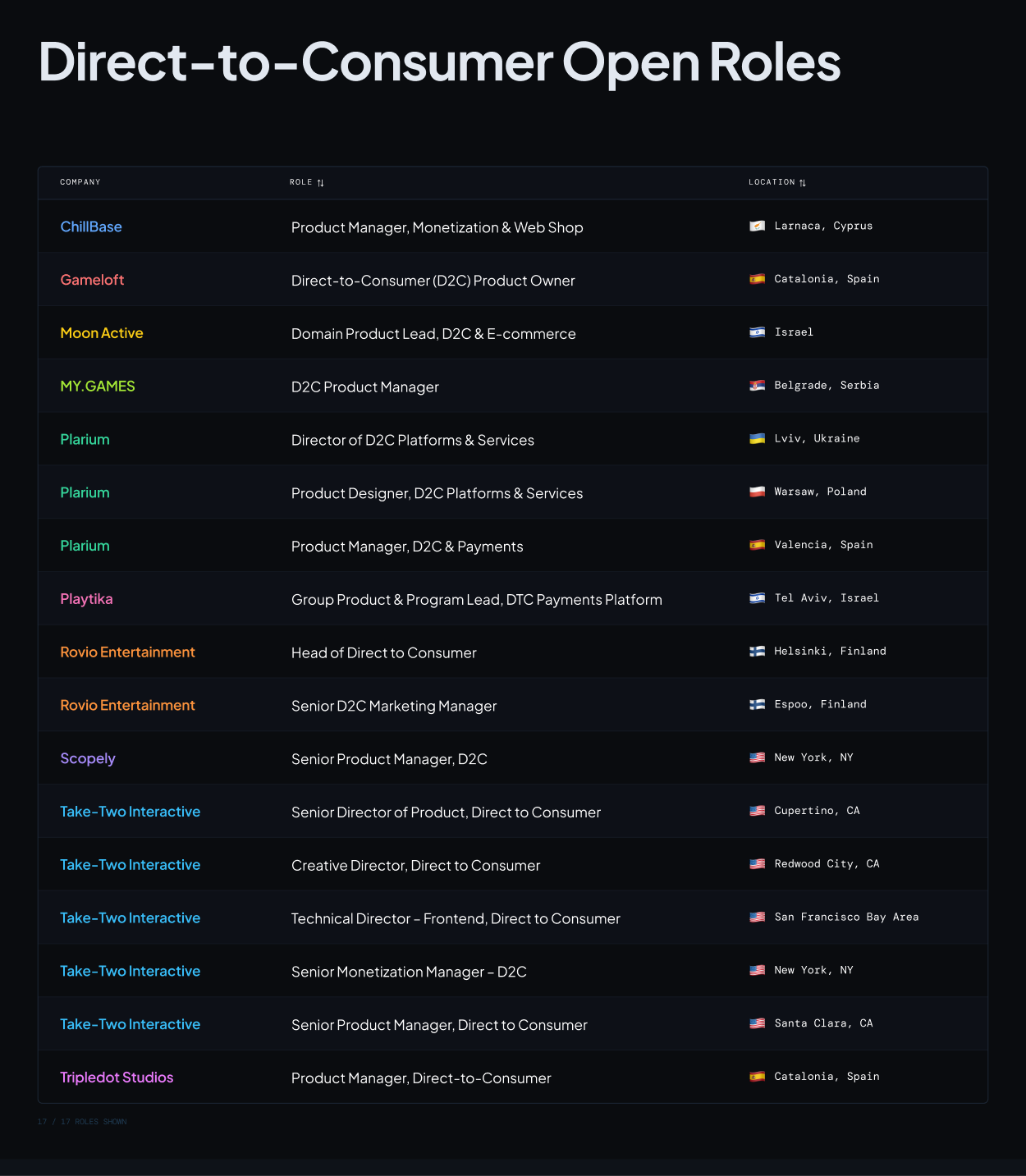
Roles are captured through periodic scrapes rather than continuous monitoring; some listed here may since have been filled, and several publishers appear more than once across the tracking period.
In fact, Appcharge's survey with GDC Festival of Gaming, covering more than 1,200 game industry professionals, backs this up: 54% of studios have zero dedicated DTC employees. Only 25% describe their strategy as scaling or mature. 14% consider themselves ahead of the industry; 62% say they're behind. The publishers opening these roles are, in effect, that 14%.
But what exactly do these jobs entail? And are they scaling infrastructure built internally, or using external platforms?
Build, buy, or a bit of both: The DTC reality
From what we’ve seen, "build or buy" is too clean a frame for what the job actually is. Each of these owners is deciding, in their own lane, what the studio builds and what it hands to a third party partner: the web store here, the checkout there, payments infrastructure somewhere else, and remaking that call as the studio's needs change. Some studios decide the simpler path is handing the entire stack to one DTC partner and building none of it themselves.
And as for the number of DTC-dedicated leaders needed in each company, Maor Sason, our CEO, put it plainly in a recent interview: "If you're fully working with Appcharge, you don't need 14 people. You need two or three dedicated people who understand the channel and can coordinate across the organization... The real point isn't the number. It's more about the commitment." That commitment is the job: managing a shifting mix of what's built and what's bought, continuously.
What's left to solve from there is friction, not philosophy. Maor has said as much directly: regulatory shifts like Google's ECL program, or a leadership change that stalls momentum because the one person keeping DTC on the roadmap just left. Those are exactly the problems these owners exist to absorb, and why more of these roles keep opening every quarter.
Questions to ask your studio
So look at your own studio. Which function actually owns DTC: shared across several, or sitting with one person? Are there real goals and KPIs attached to it? How much of your team's time and budget is it actually getting, relative to what it returns? If DTC is 20% of your revenue and half your profit, but only 5% of your headcount and budget, something is off.
Multiply that gap across the industry, and the next hiring wave makes sense.
The next 22 will look different from the last 22: fewer first hires, more people reporting into owners who already exist. The organization is catching up to the channel. Once it does, the question stops being whether DTC needs a home, and starts being how big that home gets.


