

How We Engineered the Fastest Loading Web Stores in Mobile Gaming


A small ask from a top ten publisher whose web store we power turned into a key engineering project at Appcharge. The short version: our web store is now the fastest we've measured anywhere in mobile gaming. The long version is what they asked for, what it actually took to get there, and how we improved our web store load time by 74%.
The Before
Our web store runs as a single-page app, and opening it means downloading around 1.36 MB of compressed JavaScript before a single product appears. It's the one screen in the product where speed and revenue are so closely interlinked, so how fast that happens matters more here than almost anywhere else in a game's monetization stack.
We'd already invested heavily in that: an instant loading screen, followed by the real store once everything had loaded behind it. It tested well.
Then this publisher asked us to go further. What they wanted was the actual content on screen sooner, not a better-looking wait while the same amount of code loaded behind it.
Speed is several numbers that fight each other
Web performance gets measured across a handful of metrics: how fast the first pixel appears, how fast the main content settles, how much the layout jumps around while it loads, how long the page ignores a tap while it's busy processing. Google's Core Web Vitals treat these as separate, weighted signals, not one composite score.
They compete with each other constantly. Load images earlier and the layout-stability metric can get worse. Preload a file expecting it to help, and a measurement tool can register it as a regression even when the real, observed experience didn't change. Most performance advice treats speed like a single dial to turn up, when it's really a set of trade-offs: fixing one metric can quietly break another, and that shows up immediately in how a store feels to use.
What actually moved the numbers
The biggest change came from rethinking what the browser has to download before it can show anything at all.
We rebuilt how our web components library loads, so a store fetches only the pinpointed UI templates it actually uses, and starts fetching them before a single line of the main application code has run.
We also went after the smaller, invisible costs studios rarely think to check: a device-detection library that alone cost 125 KB and a 300-millisecond processing freeze, third-party scripts loading before anyone needed them, and rethinking the order of the store load operation.
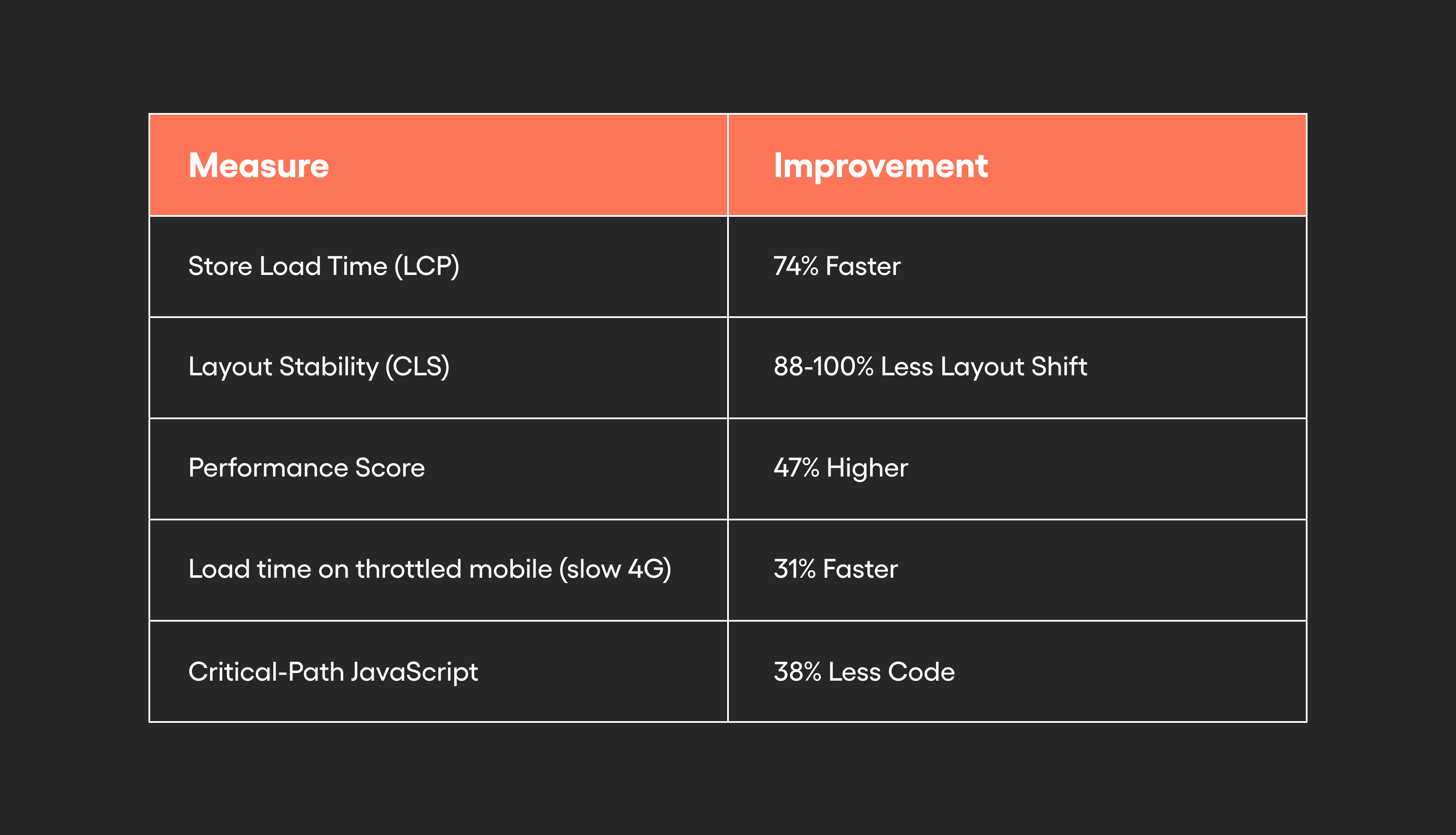
Here are the resulting improvements:
Distrusting our own instincts
What made this process of optimization work so well was being thorough - not accepting one measurement then quickly moving on.
We built a testing harness that reproduces real network conditions, slow 4G, regular 3G, a mid-range phone's processor, and every result we report is a median across multiple cold loads, because a single test tells you whatever you want to hear.
We've also learned to distrust our own instincts. One change we were confident about turned out to do nothing once measured properly. Another looked like a clear win until we tested it on a worse connection.
That habit, measuring honestly before declaring a win, is why we can confidently call our web store the fastest we've seen anywhere in mobile gaming, backed by numbers we can rerun and defend.
What this means for the web stores built with Appcharge
Most publishers will never see this work directly. What they'll see is a player who opens the web store and finds their offer, their bundle, their event, without any friction or waiting time. On a real mobile connection, every extra second before the web store appears is a second a player can decide to do something else instead.
At the scale our partners work with, even the smallest percentage increase in conversion rate - which is the product of faster UX and load speed - can bring meaningful growth to DTC margins.
We hold every release to that same bar now: fast on a real phone, on a real network, and proven before it ships.


