

We Prepare for Black Friday the Same Way Game Studios Do


Your October probably looks familiar. You plan the offer arc. You test your systems. You build the rota. You brace for the spike. Ours looks the same.
Every November, hundreds of games run their biggest weekend of the year through Appcharge at the same time, seeing spikes in traffic and sales.
For every one of them, the goal is the same: a web store and checkout that feel exactly like they do on any other day.
Here's what goes into that, from the strategy sessions weeks before the sale to the people in our office through the weekend.
Planning your own Black Friday? Download the Black Friday Web Store Playbook: eight moves from our monetization team, in the order you'll make them.
Planning monetization strategy together
In the month or two prior to Black Friday, Gili Avneri, our Director of Monetization, and his team sit down with our partners to work through it together. Gili’s team brings what they’ve seen work across the games we support. You bring what you know about your players.
Here’s what those sessions tend to cover.
One calendar, from October to January. Halloween, Thanksgiving, Black Friday, Cyber Monday, the December holidays, and on into Lunar New Year, all in a single view. We look at where your weekends are already strong and where weekdays need a lift. We plan the quiet weeks too, because a recovery week after a big event protects the next one.
Building the desire to buy. The days before a big sale shape how it lands. A short pre-sale 12 to 24 hours out warms players up, while a deep discount right before the event teaches them to hold back and wait. Many teams also tune their in-game economy in the run-up, so players arrive at the sale ready to spend.
Offers that build. Once the event starts, each day’s offer should beat the one before, with a bigger bonus or a better bundle every 12 to 24 hours and a visible timer on each. That gives players a reason to come back tomorrow. New features wait until after the peak weekend, when players are coming off a spending high. Your economy team joins early, so a generous sale doesn’t leak value from the game.
A web store that looks like the event. Players should recognize the web store as part of the same moment as the game. That means matching store copy to your in-game event name, swapping in seasonal art, and localizing for the holidays that matter in each market, like Thanksgiving in the US or Lunar New Year in Asia.
Getting players there. The best offer only works if players see it. We plan the path from game to web store: in-game banners, email timed across time zones, direct links for VIP and lapsed players, and community managers briefed before each drop.
Stress testing every week
"You don't prepare for Black Friday one week before," says Oz Giat, our Director of Infrastructure. "You just can't. You prepare for Black Friday every day."
That's how we run. Gaming traffic is hard to plan for. Oz came to Appcharge from Moon Active, and he describes studio traffic as "sharp, short peaks," exactly the kind infrastructure struggles with. So we stress test every week, on every product change, every new feature, every configuration change, and every feature flag switched on or off. We push traffic far past what we expect, find where things start to slow down, fix it, and run it again.
Last Black Friday, a major publisher asked us to step in at short notice. Our team monitored the operation around the clock, testing every edge case across devices, countries, and localization, while the platform took the extra traffic with room to spare. "It was another day at the office for the Appcharge infrastructure team," Oz recalls.
It also changed how we plan. We used to plan for the additional traffic that seemed reasonable. Today, we plan for the physical maximum: every player our partners have, arriving at once. And we test layer by layer: the money path first, then everything that supports it.
Hunting for bottlenecks
Daniel Nagar, one of our longest-serving software architects, built the tool behind those tests. It runs agents simultaneously, placing stress on the platform and producing a report of every bottleneck it finds.
"Regular traffic, 2x traffic, 5x traffic, 10x traffic, 20x traffic, 200x traffic," Daniel says. "And each time we try to see where the bottlenecks are, what's starting to slow down, what starts to break."
Find the bottleneck, fix it, run it again. It isn't always where you'd expect: a bottleneck can sit in a service upstream, in one downstream, or inside the service being tested.
Tracking every flow continuously
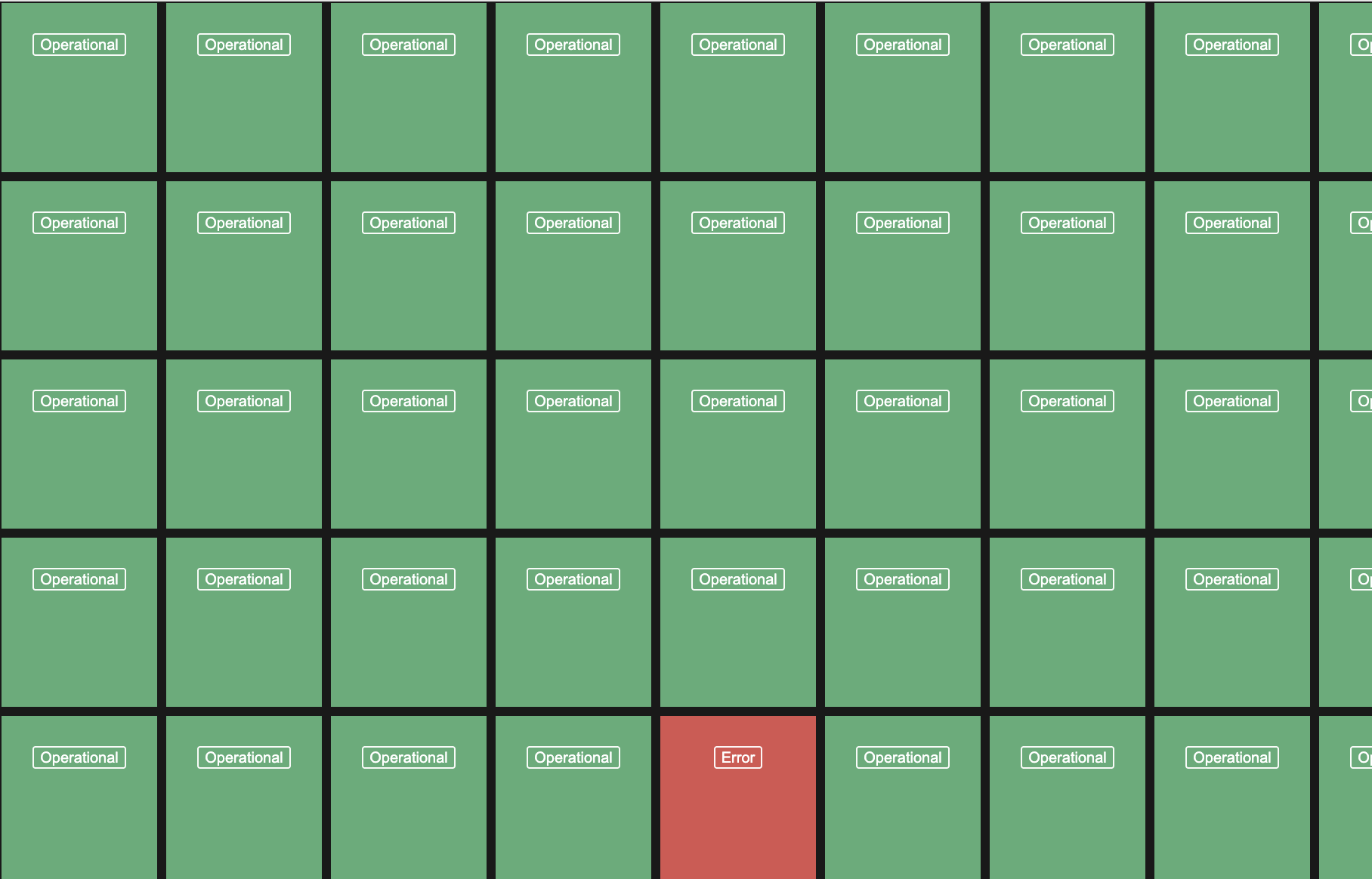
Every few seconds, we run the same flows your players take through web stores and checkout, from regions around the world, and measure how each one feels. Each green cube in the image above reflects a user flow that is working as expected. If one slows down past its threshold, the cube turns red, and our engineering and operations teams are paged.
Staying up is only the starting point. "This is binary, like on and off," Oz says of uptime. "If you're off, you're off." What your players feel is speed, which is why we measure latency, flow by flow. In the weeks before Black Friday, Oz's team adds even more player flows to the checks.
Watching every release under real traffic
Every release passes our test gates before it ships. Some issues only show up under real traffic, so our infrastructure team runs an AI agent they call "the overseer." As a new version of a service is gradually promoted to production, it compares the service's behavior with how the previous version ran, through every stage of the rollout and for hours afterward. Oz calls it a compensating control, a check for the areas where writing a test for everything isn't realistic, and something "you couldn't do before the AI era." Agents suggest fixes when alerts fire. Our engineers make the final call.
In the weeks before Black Friday, we also slow down what ships. Two or three weeks out, every change gets the same question: is it urgent, or can it wait until after Black Friday? "It's better to have what we have right now," says Rony Sason, an Engineering Manager in our monetization R&D group, "than adding something small and risking it breaking even the smallest part of the system. It's not worth the risk."
In the room all weekend
From three days before Black Friday until two days after, our team works around the clock from the office, in shifts. Being on call isn't new for us. What changes is having everyone in one room. "If there is an issue, we can communicate faster together with other teams and departments," Oz says.
Oz compares good infrastructure to electricity: "Nobody cares about it. You don't think about it." That's the goal. If we've done our job, you won't think about us that weekend. You'll be watching your offers land.
Planning your own Black Friday? Download the Black Friday Web Store Playbook: eight moves from our monetization team, in the order you'll make them.


